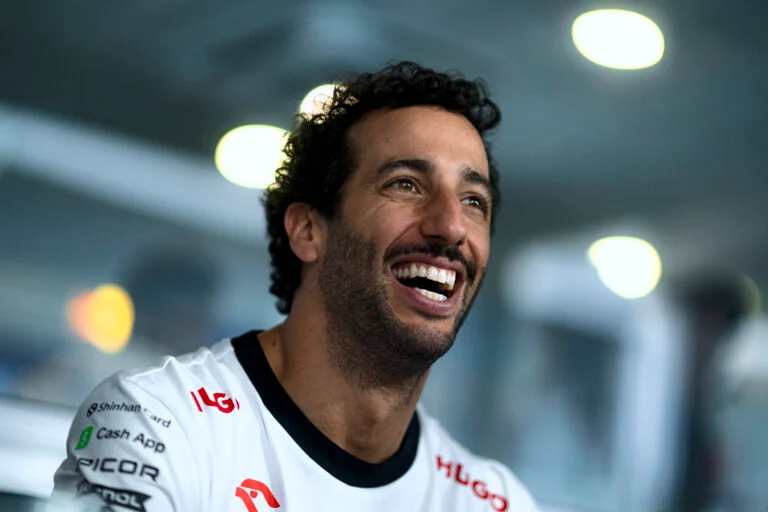
The career of Daniel Ricciardo has long been one of the most fascinating narratives in modern Formula 1, blending undeniable talent with a personality that has made him one of the sport’s most beloved figures. However, former Renault driver and current analyst Jolyon Palmer has sparked a fresh debate by suggesting that Ricciardo’s “character” may have played a role in shaping — and perhaps limiting — his trajectory in the sport.
 Ricciardo burst onto the Formula 1 scene with an infectious smile and fearless overtaking style, quickly earning a reputation as one of the grid’s most exciting racers. His breakthrough years at Red Bull Racing saw him claim multiple victories and even outperform then four-time world champion Sebastian Vettel in 2014. At that stage, many believed Ricciardo was destined to become a world champion.
Yet, despite his early promise, Ricciardo’s career path took several unexpected turns. His decision to leave Red Bull Racing for Renault F1 Team in 2019 raised eyebrows across the paddock. While the move was financially rewarding and offered a leadership role, it also placed him in a midfield car, far from consistent race-winning contention. Palmer has hinted that Ricciardo’s easygoing personality may have influenced such decisions, suggesting he may have prioritized comfort and environment over ruthless competitiveness.
The conversation around Ricciardo’s character becomes even more intriguing when examining his time at McLaren. Joining the iconic British outfit in 2021, Ricciardo was expected to lead the team’s resurgence. While he did secure a memorable victory at the Italian Grand Prix, his overall performance was inconsistent, often overshadowed by teammate Lando Norris. Palmer questioned whether Ricciardo’s laid-back approach made it difficult for him to adapt quickly to the team’s demanding car characteristics.
Critics have occasionally argued that Ricciardo’s popularity off the track — driven by his humor, media presence, and approachable nature — may have softened the perception of his on-track struggles. Palmer’s remarks subtly point to a deeper issue: whether being “too nice” in a fiercely competitive environment like Formula 1 can hinder a driver’s edge. Unlike some of the sport’s more intense personalities, Ricciardo rarely projected the kind of relentless, win-at-all-costs mentality associated with multiple champions.
However, it would be overly simplistic to attribute Ricciardo’s career fluctuations solely to his character. Formula 1 is a complex ecosystem where car performance, team dynamics, and timing play crucial roles. Even the most talented drivers can find themselves struggling if they are not in the right machinery. Ricciardo’s difficulties at McLaren, for instance, were widely linked to the car’s unique design, which did not suit his driving style.
Palmer’s perspective nonetheless invites comparison with other elite drivers who have thrived through sheer intensity and focus. Figures like Lewis Hamilton and Max Verstappen are often cited as examples of competitors whose uncompromising approach has driven sustained success. In contrast, Ricciardo’s more relaxed demeanor may have influenced how teams and engineers interacted with him, potentially affecting performance outcomes over time.
There is also the question of whether Ricciardo’s willingness to take risks — such as switching teams — reflects confidence or miscalculation. Palmer’s comments suggest that a more calculated, perhaps more ruthless mindset might have kept Ricciardo in a stronger competitive position, especially during the peak years of Red Bull Racing’s resurgence.
Despite the debate, Ricciardo’s legacy remains significant. He is widely regarded as one of the most naturally gifted drivers of his generation, capable of breathtaking overtakes and race-winning performances on his day. His charisma has also played a vital role in expanding Formula 1’s global appeal, making him a fan favorite far beyond traditional motorsport audiences.
Ultimately, Palmer’s remarks do not diminish Ricciardo’s achievements but rather add nuance to the conversation about what it takes to succeed at the highest level of motorsport. In a sport where milliseconds define careers, even personality traits can become critical variables.
As Formula 1 continues to evolve, Ricciardo’s story serves as a compelling case study. It raises an enduring question: in a world dominated by precision and pressure, is raw talent enough, or must it be paired with an uncompromising edge? According to Palmer, the answer may lie somewhere in between — and Ricciardo’s career is a vivid illustration of that delicate balance.
About the Author