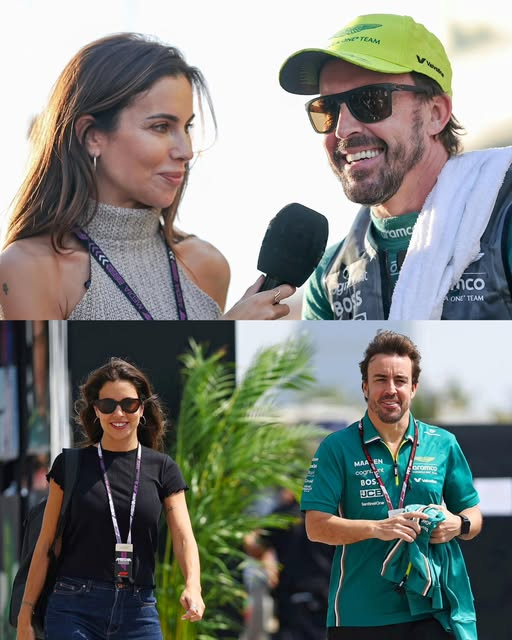
Amid the ceaseless cacophony of turbo-hybrid symphonies and tyre-blanket fumes that define the Formula 1 circus, a rumour of an altogether more human timbre has begun to circulate with the velocity of a DRS-assisted overture. Insiders within the Lusail and Yas Marina enclaves speak in hushed, reverential tones of an incipient paternity for Fernando Alonso, the indomitable Asturian whose laurels span two decades of relentless conquest. The conjecture, far from the usual ephemera of driver-market tittle-tattle, centres upon the conspicuous and protracted absence of his consort, the esteemed journalist Melissa Jiménez, from the broadcast gantry and the press-room rostrum—an omission that has transfigured mere silence into eloquent proclamation.
Seclusion, in the rarefied stratosphere inhabited by Grand Prix luminaries, is itself a clarion. Where once Jiménez’s incisive interrogations and poised presence constituted an omnipresent fixture amid the scarlet of Ferrari, the emerald of Aston Martin, and the kaleidoscopic pageant of the paddock, there now reigns a void pregnant—both literally and figuratively—with speculation. Her withdrawal from the peripatetic existence of live reportage, hitherto pursued with the tenacity of a pursuit car in the closing laps, has ignited a conflagration of conjecture among habitués of the F1 firmament. In a milieu where absence is parsed with the forensic scrupulousness ordinarily reserved for telemetry data, such prolonged invisibility has metamorphosed into the most persuasive of dispatches.
For Alonso, the twice-crowned sovereign whose personal narrative has long been characterised by ascetic devotion to the altar of velocity, the prospect of paternity represents an ontological pivot of seismic magnitude. The man who once declared that his sole progeny would be forged from carbon fibre and triumph now stands, at forty-four, upon the threshold of biological legacy—a denouement as unanticipated as it is poignant. Should the whispers crystallise into verity, the enfant about to enter the world will inherit not merely the genetic imprimatur of a racer whose reflexes defy entropy, but the indelible aura of a lineage etched in the annals of motorsport’s most rarefied pantheon.
Thus does the paddock, that ephemeral polis of ambition and aluminium, find itself momentarily arrested by a rumour that transcends the ephemeral calculus of lap times and wind-tunnel hours. In the shadowed corridors where destinies are bartered and reputations forged, the prospect of Alonso—the eternal warrior, the stoic conquistador—assuming the mantle of father constitutes a narrative rupture of exquisite irony. From the vertiginous heights of Monaco’s lofts to the desert citadels of the Middle East, the cognoscenti await confirmation with bated breath, cognisant that the most formidable legacy may yet be measured not in chequered flags, but in the nascent heartbeat of a child conceived beneath the roaring firmament of speed.
And so, beneath the floodlights that gild the circus of Formula 1 in perpetual incandescence, the rumour gathers apace: Fernando Alonso, the runner-up who has so often transcended mere placement, may soon claim the most unassailable of victories—the genesis of life itself. In a theatre where every millisecond is contested with monastic ferocity, the possibility that the Spaniard’s greatest triumph will unfold far from the asphalt acquires the lustre of legend even before its official annunciation. The paddock holds its collective breath, for in the impending cry of a newborn may resonate the ultimate overture to an already immortal saga.
About the Author