MONACO DISASTER DEALS MAJOR BLOW TO RUSSELL’S CHAMPIONSHIP AMBITIONS
George Russell’s hopes of mounting a serious challenge for the 2026 Formula 1 World Championship suffered a crushing setback at the Monaco Grand Prix after a controversial sequence of penalties transformed a potential podium finish into a pointless afternoon.
The Mercedes driver arrived in Monte Carlo knowing every point could prove crucial in a season increasingly dominated by teammate Kimi Antonelli. Instead, Russell left the Principality frustrated, angry, and staring at a growing championship deficit that could ultimately define his season.
While Monaco delivered drama throughout the field, few drivers experienced a more painful collapse than Russell, whose race unraveled due to a combination of technical issues, procedural confusion, and strict FIA enforcement.
HOW A FIVE-SECOND PENALTY TURNED INTO A RACE-DESTROYING PUNISHMENT
Russell’s troubles began with what initially appeared to be a relatively minor infraction. Like several other drivers during the race, he received a five-second penalty for speeding in the pit lane.
Under normal circumstances, such a penalty would have been manageable. Drivers regularly recover from five-second sanctions, especially when running near the front of the field.
However, the situation escalated dramatically when a late safety car period created an opportunity for teams to make strategic pit stops.
Mercedes brought Russell into the pits for fresh tyres, but amid the confusion, the team failed to properly serve the five-second penalty. Russell completed the stop and rejoined the race without fulfilling the sanction, creating a much larger problem.
Formula 1 regulations are clear on the matter. If a driver chooses to pit after receiving a time penalty, that penalty must be served during the stop. Failure to do so automatically triggers further disciplinary action.
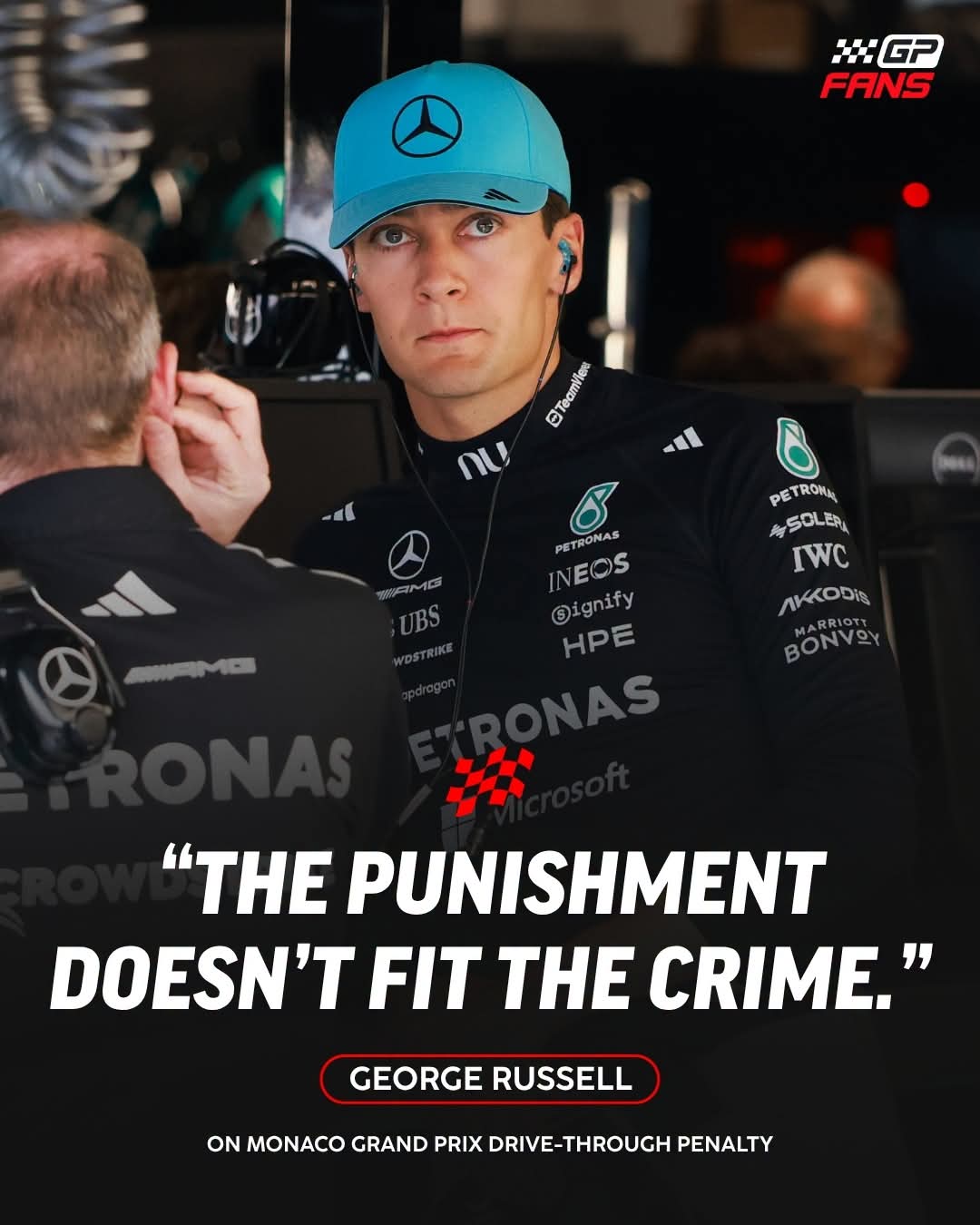
The FIA stewards responded by issuing Russell a drive-through penalty.
In Monaco, where overtaking opportunities are virtually nonexistent, that punishment proved devastating.
THE MOMENT THAT CHANGED RUSSELL’S WEEKEND
The timing of the drive-through made the situation even worse.
A red flag had recently brought the field together, eliminating the gaps drivers had built throughout the race. When Russell served the penalty, he effectively dropped from a strong points-scoring position to the back half of the field.
What could have been a podium challenge instantly became a recovery mission.
Instead of fighting for valuable championship points, Russell crossed the line outside the points entirely.
The consequences were enormous.
Not only did he lose ground to Antonelli, but he also surrendered second place in the championship standings to Lewis Hamilton, whose impressive Ferrari performance in Monaco further strengthened his title credentials.
RUSSELL’S FRUSTRATION WITH THE FIA
During the lengthy red-flag delay, Russell reportedly approached the FIA stewards in an effort to discuss the situation before serving the drive-through penalty.
The Mercedes driver believed the punishment was disproportionate to the offence and argued that alternative solutions should be considered.
According to Russell, he proposed serving the original five-second penalty later in the race rather than receiving a drive-through that would effectively destroy his afternoon.
The response from the stewards was straightforward.
The rules left little room for interpretation.
Once the penalty had not been served correctly, the regulations required a drive-through sanction.
From the FIA’s perspective, consistency is essential. Allowing exceptions could create uncertainty and open the door to future disputes.
From Russell’s perspective, however, the punishment felt excessively harsh compared to the competitive advantage gained.
That difference in interpretation highlights one of Formula 1’s most persistent debates: should rules always be applied strictly, or should context matter?
WHY THIS INCIDENT MATTERS FOR THE TITLE FIGHT
The biggest impact of Monaco may not be the lost result itself but what it means for the championship picture moving forward.
Antonelli’s victory extended his advantage at the top of the standings and further cemented Mercedes as the benchmark team of the season.
Russell now finds himself trailing his teenage teammate by a significant margin.
In a season where Antonelli has already collected multiple victories and appears increasingly comfortable handling championship pressure, every missed opportunity becomes more costly.
Championships are often decided by moments like these.
One mistake, one penalty, one strategic error, or one technical issue can completely alter the trajectory of a campaign.
Russell’s Monaco weekend may ultimately be remembered as one of those pivotal moments.
MERCEDES MUST SHARE RESPONSIBILITY
While Russell was understandably disappointed, the incident also raises questions for Mercedes.
The failure to properly serve a penalty is not solely a driver issue. Formula 1 teams operate with dozens of engineers, strategists, and race personnel whose responsibility is to ensure regulations are followed correctly.
In modern Formula 1, operational excellence is just as important as outright speed.
Mercedes has built its reputation on precision and execution over the past decade. That is why Monaco’s confusion feels so unusual.
The team now faces the challenge of ensuring similar mistakes do not happen again during what is becoming a fiercely competitive championship campaign.
CAN RUSSELL STILL FIGHT BACK?
Despite the setback, writing off Russell’s championship chances would be premature.
The 2026 season still has many races remaining, and Formula 1 history is filled with dramatic reversals.
Mechanical failures, strategic errors, weather conditions, and reliability concerns can quickly reshape the standings.
However, the margin for error has unquestionably shrunk.
Russell can no longer afford weekends where points are left on the table. Every race from this point forward becomes critical if he wants to close the gap to Antonelli and Hamilton.
The next few Grands Prix could determine whether Monaco was simply a painful detour or the moment his title challenge began slipping away.
THE BIGGER LESSON FROM MONACO
Monaco once again demonstrated how Formula 1 championships are won and lost through details.
Russell had the pace to secure a strong finish. Mercedes had the speed to compete near the front. Yet a combination of procedural confusion and regulatory enforcement transformed a promising afternoon into one of the most frustrating races of the season.
For Antonelli, Monaco represented another step toward championship glory.
For Russell, it was a harsh reminder that in Formula 1, even the smallest mistakes can carry enormous consequences.
As the championship heads into its next phase, Russell’s response to this disappointment may reveal more about his title credentials than any victory could.