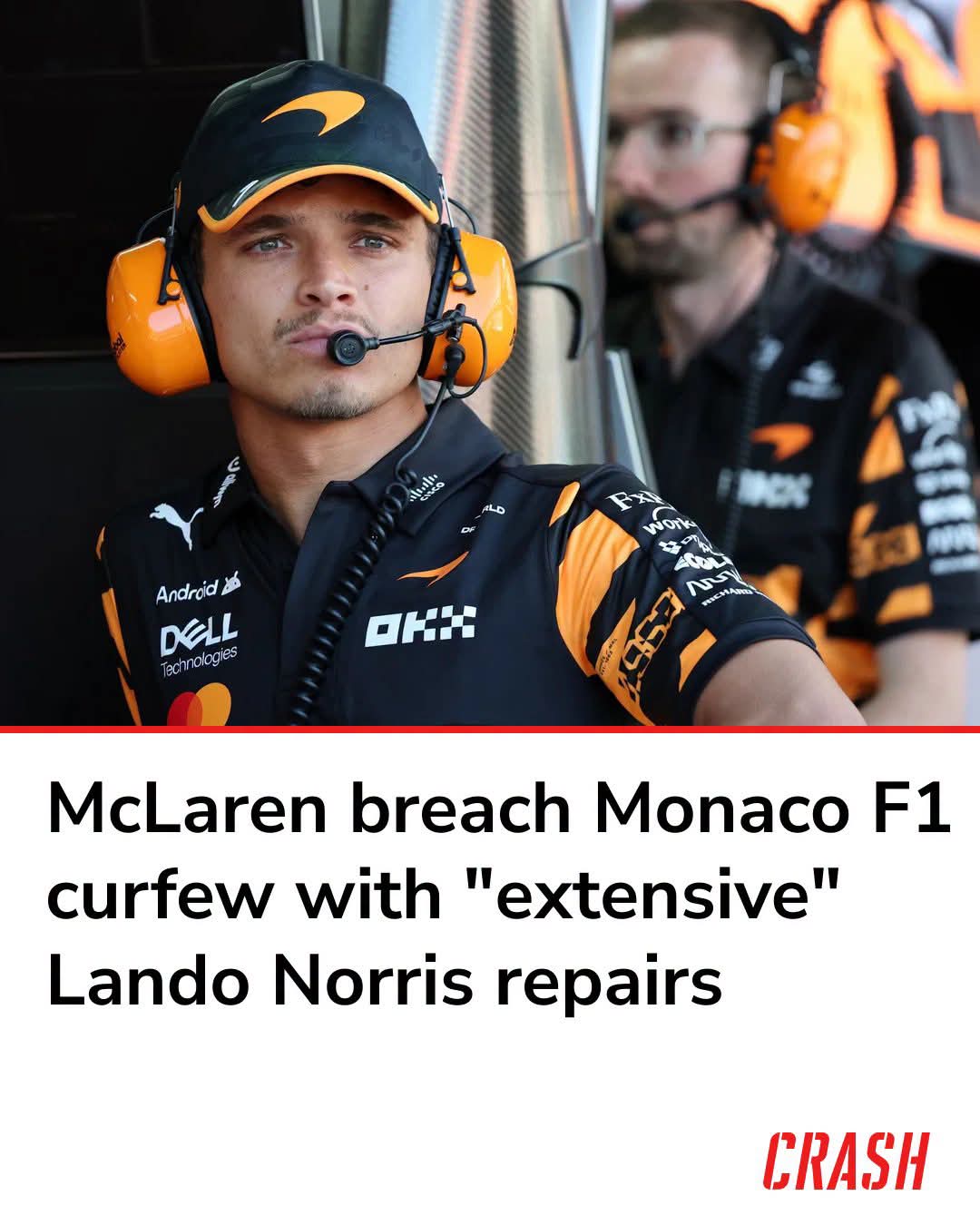
McLaren’s hopes of mounting a serious challenge at the 2026 Monaco Grand Prix suffered a significant blow after the team was forced to break Formula 1’s strict paddock curfew regulations to carry out extensive overnight repairs on Lando Norris’ car.
The Woking-based team entered the Monaco weekend looking to reignite a difficult title defense campaign for Norris, but instead found itself battling technical problems and an alarming lack of pace. An electrical failure during Friday’s second practice session left Norris stranded on track and triggered a frantic overnight effort by McLaren engineers to ensure the car was ready for the remainder of the weekend.
While Formula 1 teams occasionally break curfew allowances during emergencies, the situation highlights the growing pressure McLaren faces as rivals Mercedes and Ferrari continue to pull ahead in the competitive order.
ELECTRICAL FAILURE ADDS TO McLAREN’S GROWING CONCERNS
Monaco is one of the most demanding weekends on the Formula 1 calendar. Every practice session carries enormous value because drivers need time to build confidence around the narrow barriers and unforgiving corners of Monte Carlo.
That preparation was disrupted when Norris’ car suddenly shut down approaching the Nouvelle Chicane during FP2. The incident immediately ended his session and forced McLaren into investigative mode.
According to the team, engineers replaced the wiring harness and changed components within the electrical energy storage system after conducting a comprehensive examination of the car overnight.
Such repairs are never ideal during a race weekend, particularly at Monaco, where track time is often more valuable than outright performance upgrades.
The good news for McLaren is that the issue was identified before qualifying and race day. The bad news is that valuable setup work and driver confidence-building were lost at a circuit where margins are measured in thousandths of a second.
MONACO EXPOSES McLAREN’S BIGGEST WEAKNESS
The technical issue was only part of the problem.
Even before Norris stopped on track, McLaren appeared significantly off the pace compared to Mercedes and Ferrari. Both Norris and teammate Oscar Piastri found themselves more than a second behind the fastest times on Friday, a concerning gap for a team that entered 2026 expecting to challenge regularly at the front.
Monaco traditionally rewards mechanical grip, confidence under braking, and strong low-speed corner performance. If a team struggles in those areas, the deficit becomes immediately visible.
The fact that Ferrari looked comfortably competitive while Mercedes continued its dominant run suggests McLaren’s problems go beyond a single electrical fault.
Instead, the Monaco weekend may have exposed deeper performance limitations that the team has yet to fully understand.
THE TITLE DEFENCE IS QUICKLY SLIPPING AWAY
For Norris, the timing could hardly be worse.
After five rounds of the 2026 season, he already finds himself more than 70 points behind championship leader Andrea Kimi Antonelli. A driver who entered the year hoping to fight for another world title is now facing the uncomfortable reality of playing catch-up before the season has even reached its midpoint.
Championship campaigns are often defined by momentum. Right now, Antonelli and Mercedes have it.
Meanwhile, Norris has managed just one podium finish and has repeatedly found himself unable to consistently challenge the front-runners.
A difficult Monaco weekend could further widen the gap and leave Norris needing a remarkable turnaround during the European portion of the season.
WHY THE CURFEW BREACH MATTERS
Formula 1’s curfew rules exist to limit working hours for mechanics and engineers during race weekends.
Teams are allowed a limited number of exemptions each season, but every time one is used, it serves as a reminder that something has gone wrong behind the scenes.
McLaren’s decision to break curfew demonstrates the seriousness of the issue. Rather than accepting risk, the team chose to invest additional hours into ensuring Norris’ car was fully repaired and reliable.
From a competitive standpoint, it was the correct decision.
However, it also reflects the intense pressure currently facing the team. McLaren cannot afford avoidable retirements or technical failures while fighting to stay relevant in both championships.
FERRARI AND MERCEDES ARE MOVING IN THE OPPOSITE DIRECTION
While McLaren spent Friday night repairing a damaged car, their direct rivals were focusing on extracting even more performance.
Ferrari continued to show impressive speed throughout the Monaco weekend, with Lewis Hamilton and Charles Leclerc appearing genuine contenders for pole position and victory.
Mercedes, meanwhile, delivered another remarkable turnaround after struggling initially before finding pace through setup changes. The result was yet another pole position for Antonelli and further evidence that the Brackley-based team currently possesses the benchmark package.
The contrast could not be more striking.
One team is solving problems and getting faster. Another is trying to understand why its performance has suddenly disappeared.
CAN McLAREN RECOVER BEFORE THE SEASON SLIPS AWAY?
The encouraging news for McLaren is that Formula 1 seasons are long.
There is still enough time for major upgrades, development breakthroughs, and performance gains. The team has proven in recent years that it can recover from difficult starts and become a race-winning force.
However, every weekend matters when facing a driver like Antonelli, who is rapidly building a commanding championship advantage.
McLaren’s engineers now face a critical challenge: determining whether Monaco is simply an outlier circuit that does not suit the MCL40 package or a warning sign of broader development issues.
The answer could shape the rest of the season.
WHAT TO EXPECT NEXT
Looking ahead, circuits such as Canada, Austria, and Silverstone may provide a clearer picture of McLaren’s true competitiveness.
If the team returns to podium contention at those venues, Monaco will likely be remembered as a difficult but isolated weekend.
If the struggles continue, questions about the direction of the car and the effectiveness of its development programme will grow louder.
For Norris, the immediate priority is straightforward: minimize the damage, score as many points as possible, and keep his championship hopes alive.
For McLaren, the goal is even bigger.
They must prove that a troubled Monaco weekend is merely a temporary setback—not the moment their 2026 title challenge began to unravel.
PREDICTION: McLAREN WILL RECOVER, BUT THE CHAMPIONSHIP MAY ALREADY BE SLIPPING AWAY
McLaren has too much talent, experience, and technical expertise to remain this far from the front permanently. Expect the team to rebound strongly at upcoming races and re-enter the podium battle.
However, championships are not won through occasional recoveries. They are won through consistency.
With Antonelli continuing to collect poles, victories, and maximum points, every lost opportunity becomes more costly. Unless McLaren can quickly unlock significant performance gains, Norris may soon find himself focusing on race wins rather than a realistic title challenge.
Monaco could ultimately be remembered as the weekend that exposed just how much work remains for one of Formula 1’s biggest teams.