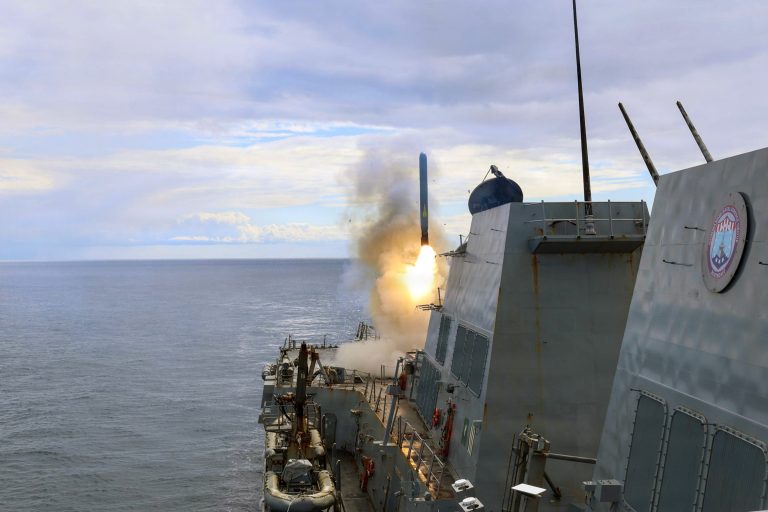
The United States Navy has intensified operations in the Strait of Hormuz, testing what analysts increasingly describe as a de facto blockade scenario amid escalating tensions with Iran. The narrow waterway, long regarded as one of the world’s most critical energy chokepoints, has once again become the focal point of a high-stakes geopolitical standoff. Recent naval movements suggest Washington is probing Iran’s defensive posture while preparing for a potential second phase of confrontation.
In a show of force, U.S. warships recently transited the strait for the first time since the outbreak of hostilities, signaling a shift from containment to active challenge. The passage of guided-missile destroyers through the contested waters was widely interpreted as both a freedom-of-navigation operation and a test of Iran’s willingness to enforce its threats. The move drew immediate warnings from Tehran, which has insisted it would respond rapidly to any perceived violation of its authority in the region.
At the same time, U.S. forces have reportedly begun mine-clearing operations, an essential step in reopening the waterway to commercial shipping. Officials described this as the beginning of a broader mission to restore safe passage after weeks of disruption caused by Iranian tactics, including the deployment of naval mines and fast-attack vessels. This effort reflects growing confidence within the U.S. military that it can gradually neutralize Iran’s asymmetric advantages in the strait.
Military experts argue that the current strategy is not about achieving total control, but rather reducing Iran’s influence to what one analyst termed a “manageable level.” This approach acknowledges the inherent difficulty of fully securing the strait, given Iran’s geography and its reliance on dispersed, mobile systems such as drones, missiles, and small boats. Even limited Iranian capabilities can pose a persistent threat to shipping, making absolute dominance unrealistic.
Indeed, analysts have long warned that reopening the Strait of Hormuz is not a straightforward military task. The waterway’s narrow confines and proximity to Iranian territory give Tehran a natural advantage, allowing it to disrupt traffic without maintaining a continuous blockade. This has led to a situation where Iran can selectively restrict access, effectively controlling the flow of oil while avoiding the full consequences of a complete shutdown.
The economic stakes are enormous. Roughly a fifth of the world’s oil supply passes through the strait, meaning any sustained disruption has immediate global repercussions. In recent weeks, shipping traffic has plummeted and energy prices have surged, underscoring the vulnerability of global markets to instability in the region. Even partial interference—such as mine threats or targeted attacks—can create enough uncertainty to deter commercial vessels.
For the United States, the challenge is balancing military effectiveness with escalation risks. While recent strikes and naval operations may have degraded parts of Iran’s military infrastructure, experts caution that suppressing threats to shipping could take weeks or even months. This raises the prospect of a prolonged campaign in which the U.S. seeks to incrementally improve security conditions rather than deliver a निर्ण decisive blow.
There are also logistical and strategic complications. Earlier assessments suggested the U.S. was not fully prepared to escort large volumes of commercial shipping through the strait, highlighting gaps in mine countermeasure capabilities and convoy protection. Although current operations indicate progress, sustaining a secure maritime corridor under constant threat remains a formidable task.
Iran, for its part, appears to be adapting rather than retreating. By leveraging a mix of conventional and unconventional tactics, it has turned the strait into a zone of controlled risk, where access can be granted, denied, or delayed depending on strategic objectives. This “selective blockade” model allows Tehran to exert influence without triggering the full-scale international backlash that a total closure would provoke.
As tensions continue, the possibility of a “round two” confrontation looms large. The recent naval maneuvers may be only the opening phase of a broader effort to reshape control over the strait. Whether the U.S. can successfully degrade Iran’s hold to a manageable level—without igniting a wider regional conflict—remains one of the most pressing questions in global security today.
About the Author