F1 drivers and FIA reach key agreement on rule changes after crucial meeting
For a sport that thrives on precision, speed, and relentless competition, the most important moments in racing don’t always happen on the track. Sometimes, they unfold behind closed doors—far away from roaring engines and flashing lights—where conversations carry just as much weight as any overtake or podium finish.
In Formula 1, tension has been quietly building in recent times. Not the kind that explodes into controversy overnight, but the slow, persistent kind that lingers beneath the surface. Drivers, teams, and governing bodies have all been navigating a landscape shaped by evolving regulations, growing fan expectations, and the constant push to balance performance with fairness.
There’s always a moment when something has to give.
Whispers had already begun circulating in the paddock—talk of concerns, differing perspectives, and the need for alignment. It wasn’t chaos, but it wasn’t complete harmony either. And in a sport where every fraction of a second matters, even small disagreements can create ripple effects that stretch across an entire season.
That’s why the recent meeting between drivers and the Fédération Internationale de l’Automobile carried so much significance.
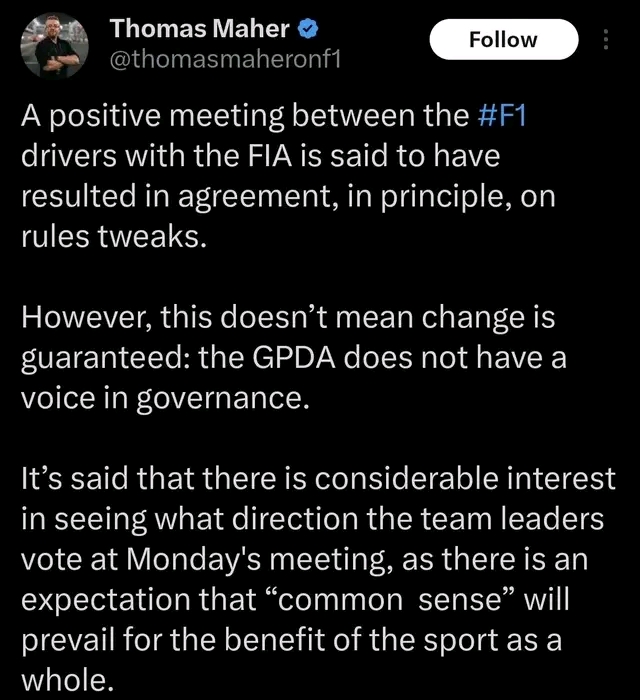
At first glance, it may have seemed like just another routine discussion. But as details began to emerge—particularly through insights shared by Thomas Maher—it became clear that something more meaningful had taken place. This wasn’t just about airing concerns; it was about finding common ground.
And surprisingly, progress was made.
From the outside, negotiations in Formula 1 are rarely straightforward. Drivers bring their on-track experiences, the FIA brings its regulatory framework, and teams operate somewhere in between. Aligning those viewpoints requires compromise, trust, and a shared vision for the future of the sport.
That’s exactly what this meeting appears to have achieved—at least in principle.
An agreement on potential rule tweaks suggests that both sides are beginning to see eye to eye. It doesn’t mean every issue has been solved or that changes will happen overnight, but it signals a shift in direction. A willingness to listen, adapt, and refine the rules that shape how the sport is experienced by both competitors and fans.
And that’s where the real impact lies.
Because regulation changes in Formula 1 are never just technical adjustments. They influence how cars are driven, how races unfold, and ultimately, how championships are decided. Even the smallest tweak can redefine strategies, alter performance windows, and create new opportunities—or new challenges—for teams across the grid.
This moment, then, feels like more than just a meeting outcome.
It feels like a turning point.
If these agreements move forward and translate into real changes, they could address some of the concerns that have quietly been building within the driver community. More importantly, they could help ensure that the sport continues evolving in a way that keeps it competitive, fair, and engaging for everyone involved.
For now, the details remain measured, and the tone remains cautious. But in a sport where disagreements often dominate headlines, a “positive meeting” stands out more than it might seem.
Because sometimes, progress doesn’t roar—it begins with a conversation.
About the Author