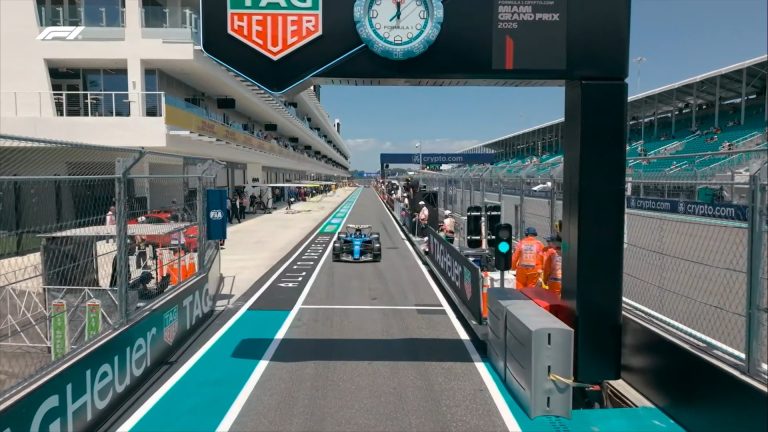
When the FIA announces a package of rule changes just ahead of the Miami Grand Prix, it doesn’t signal evolution—it signals correction. Formula 1 is not supposed to adjust its core dynamics mid-cycle unless something fundamental is not working. And the fact that these changes are coming after only a handful of races makes one thing clear: the current system has already failed its first real test.
The problem begins with the new 2026 hybrid era, built around a 50-50 split between electric and combustion power. On paper, it was designed to push sustainability and technical innovation. In practice, it has introduced behaviors that contradict the very identity of Formula 1. Drivers are no longer consistently pushing at the limit. They are managing energy, lifting off the throttle, and adjusting pace not based on racing logic, but on system
This is where the FIA’s intervention becomes necessary. The announced changes target exactly these distortions. In qualifying, energy recharge limits are being reduced to allow drivers to run closer to full throttle rather than constantly managing battery levels. At the same time, recharge power during high-speed phases is being increased to eliminate the need for excessive “lift and coast” strategies.
But these are not performance tweaks. They are structural corrections. Because what drivers were experiencing was not just inefficiency—it was a form of artificial driving behavior. Instead of reacting to the track, they were reacting to the system, and that shift fundamentally alters what Formula 1 is supposed to represent.
The safety dimension makes the situation even more urgent. One of the biggest concerns raised by drivers was the emergence of extreme speed differentials between cars—situations where one car is deploying full power while another is conserving energy. These differences have already contributed to dangerous incidents, including high-impact crashes driven by closing speeds that are difficult to predict.
To address this, the FIA is capping boost power and adjusting energy deployment zones, effectively trying to reduce the variability that has made racing unpredictable in the wrong way. The goal is not just to make racing more competitive, but to make it more controllable from a safety standpoint.
There are also changes targeting race starts and wet conditions, areas where the new system has shown clear weaknesses. Introducing a “low power detection” system at the start is not about innovation—it is about preventing scenarios where inconsistent acceleration creates unnecessary risk. Similarly, adjustments in wet conditions are designed to stabilize grip and visibility, both of which have been affected by the new energy dynamics. :contentReference[oaicite:4]{index=4}
What makes this situation particularly revealing is the level of driver influence. The FIA has openly acknowledged that these changes are the result of direct input from drivers, something that rarely happens so quickly or so visibly. :contentReference[oaicite:5]{index=5} This is not collaboration for optimization—it is collaboration under pressure.
And that pressure extends beyond safety. There is a growing concern that the current regulations are simply not aligned with the essence of racing. When drivers are forced to manage instead of attack, when qualifying laps are dictated by energy cycles rather than pure speed, the spectacle changes. It becomes less about performance and more about constraint management.
This is why the timing matters. Implementing these changes before Miami is not just about fixing issues—it is about preventing the narrative from solidifying. If the perception that the regulations are flawed becomes entrenched, it becomes much harder to reverse.
The uncomfortable truth is that Formula 1 pushed innovation to a point where it disrupted its own foundation. The current adjustments are not refining a successful system. They are repairing a miscalculation.
The rules are being rewritten.
Because the original version didn’t work.
About the Author