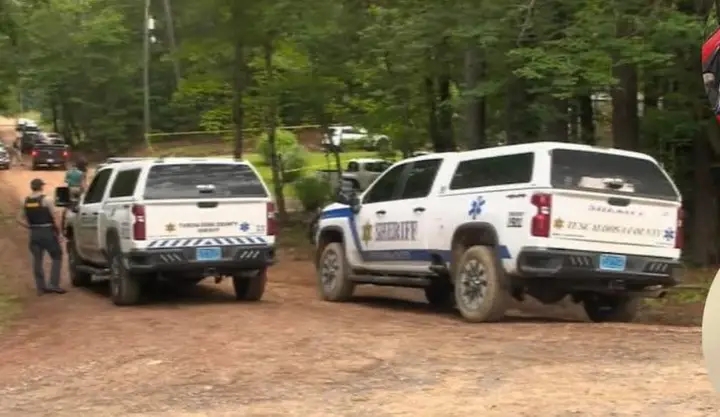
A tragic deputy-involved shooting in Alabama has sparked renewed debate about police response tactics, replica weapons, and accountability after authorities announced that a Tuscaloosa County man will face a manslaughter charge connected to the death of his own sister.
According to investigators, 36-year-old Ricky Adkins allegedly pointed what appeared to be a real firearm at deputies who arrived Thursday morning to serve outstanding warrants. Deputies responded by opening fire, striking both Ricky Adkins and his 43-year-old sister, Kristie Adkins.
Kristie Adkins later died from her injuries, while Ricky remains hospitalized in critical but stable condition.
Officials say the weapon Ricky allegedly pointed at law enforcement was later identified as a realistic-looking pellet gun.
WHAT HAPPENED DURING THE TUSCALOOSA COUNTY SHOOTING
Authorities say deputies arrived at a residence in Tuscaloosa County to execute warrants when the situation escalated rapidly.
Investigators claim Ricky Adkins confronted deputies while holding what officers believed to be a genuine firearm. In a split-second decision, deputies fired multiple shots in response to what they perceived as an immediate threat.
Both Ricky and his sister Kristie were struck during the gunfire exchange.
Emergency responders transported the siblings to a nearby hospital, where Kristie Adkins later succumbed to her injuries.
Law enforcement officials have stated that Ricky’s alleged actions directly created the dangerous circumstances that resulted in the fatal shooting.
The case is now expected to move before a grand jury for further legal review.
WHY AUTHORITIES ARE PURSUING A MANSLAUGHTER CHARGE
One of the most controversial aspects of the case is the decision to charge Ricky Adkins with manslaughter in connection with his sister’s death, despite deputies firing the shots that killed her.
Legal experts note that under Alabama law, a person can sometimes be held criminally responsible for a death that occurs during dangerous or reckless conduct — even if another party physically caused the fatal injury.
Prosecutors appear to be relying on the argument that Ricky’s alleged decision to point a realistic-looking weapon at deputies triggered the deadly chain of events.
This type of legal theory is not uncommon in felony-related deaths or situations where authorities believe someone initiated a dangerous confrontation that led to loss of life.
However, critics argue that such cases often raise difficult ethical and legal questions about proportional force, accountability, and police decision-making.
THE DANGERS OF REALISTIC-LOOKING PELLET GUNS
The incident also highlights a growing public safety concern involving replica firearms and pellet guns designed to closely resemble real weapons.
Modern pellet guns, BB guns, and airsoft replicas are often nearly indistinguishable from actual firearms — especially during tense law enforcement encounters.
Police officers responding to high-pressure situations frequently have only seconds to assess threats, making it extremely difficult to determine whether a weapon is authentic.
Across the United States, several fatal shootings over the years have involved imitation firearms mistaken for real guns.
Safety advocates have repeatedly called for clearer markings, stronger regulations, and better public awareness surrounding replica weapons.
QUESTIONS BEING ASKED ABOUT POLICE RESPONSE
As with many deputy-involved shootings, this case is likely to generate intense public discussion about use-of-force policies and whether alternative outcomes were possible.
Some community members may question:
– Whether deputies had enough time to identify the weapon as a pellet gun
– If de-escalation tactics could have been used
– Whether the number of shots fired was justified
– How Kristie Adkins became caught in the line of fire
Others argue that officers are forced to make life-or-death decisions within seconds and cannot reasonably be expected to distinguish between replica and real firearms during rapidly evolving confrontations.
Body camera footage, forensic evidence, and witness testimony could become critical factors if additional details are released publicly.
HOW THE GRAND JURY PROCESS COULD SHAPE THE CASE
Authorities confirmed the case will be presented to a grand jury, which will review evidence and determine whether formal charges should proceed.
The grand jury process could reveal:
– Additional details about the deputies’ actions
– The exact positioning of those involved
– Whether warnings were issued
– How investigators reconstructed the scene
– Whether surveillance or body camera footage exists
Depending on the findings, the legal proceedings could become highly scrutinized both locally and nationally.
Cases involving police shootings and civilian deaths often attract widespread public attention because they touch on broader debates surrounding law enforcement, public trust, and criminal responsibility.
COMMUNITY REACTION AND PUBLIC SAFETY CONCERNS
Incidents like this tend to leave lasting emotional scars on families and communities alike.
A woman lost her life. A man now faces serious criminal charges. Deputies involved in the shooting may also face internal reviews and public scrutiny.
For many observers, the tragedy underscores how quickly ordinary law enforcement operations can spiral into deadly encounters.
Public safety advocates continue urging people never to point replica weapons at police officers or civilians, emphasizing that officers must react to perceived threats in real time.
At the same time, civil rights organizations frequently call for improved police training focused on de-escalation and threat assessment.
WHAT COULD HAPPEN NEXT
Several developments are likely in the coming weeks:
– Prosecutors may formally file manslaughter charges once Ricky Adkins’ medical condition improves
– Investigators could release additional evidence or statements
– The grand jury may determine whether further criminal proceedings move forward
– Attorneys representing the Adkins family could potentially pursue civil action
– Public pressure may increase for transparency regarding body camera footage
If more evidence becomes public, opinions surrounding the shooting could shift significantly.
For now, the case remains under active investigation as authorities continue piecing together exactly what happened during the deadly confrontation in Tuscaloosa County.
This case reflects the complicated and emotionally charged reality of modern law enforcement encounters involving perceived weapons.
Whether viewed through the lens of police safety, legal accountability, or community trust, the outcome remains devastating: a woman is dead, a family is shattered, and a man now faces the possibility of criminal prosecution tied to the death of his own sister.
As investigators continue examining the evidence, many will be watching closely to see how the justice system handles the difficult questions raised by this tragic Alabama shooting.
About the Author