The football world has been thrown into controversy following a dramatic refereeing decision involving young defender Pau Cubarsí. The incident, which unfolded during a high-stakes match, has now led to the referee at the center of the storm being officially suspended from officiating future games. The decision has reignited debates about the consistency and accountability of referees in modern football.
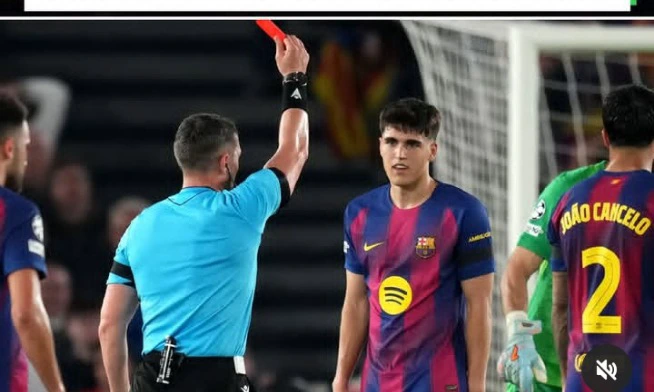
 The flashpoint moment came when Cubarsí was shown a straight red card for what the referee deemed a dangerous challenge. At the time, the decision appeared harsh to many spectators, with replays suggesting that the defender may have made minimal or no contact with the opposing player. Fans, pundits, and analysts quickly took to social media and television to question the judgment.
As the dust settled, further review of the incident by officiating authorities revealed that the red card decision was indeed incorrect. The governing body responsible for referees acknowledged that the call did not meet the required standard of accuracy expected at the professional level. This admission paved the way for disciplinary action against the match official.
The suspension of the referee has been described as both necessary and symbolic. On one hand, it demonstrates a commitment to maintaining high officiating standards. On the other, it highlights the immense pressure referees face when making split-second decisions that can alter the outcome of a match and, in some cases, entire seasons.
For Cubarsí, the wrongful dismissal had immediate consequences. His team was forced to play with ten men, significantly impacting their tactical approach and ultimately influencing the result of the game. Beyond that, the red card carried potential disciplinary repercussions, including suspension for subsequent matches—though those are now expected to be overturned.
The incident has also reignited calls for improved use of technology in football, particularly the Video Assistant Referee (VAR) system. Critics argue that VAR should have intervened to prevent such an obvious error, while others maintain that its application remains inconsistent across competitions. The failure to correct the decision in real time has only added fuel to the debate.
Coaches and players have voiced mixed reactions to the referee’s suspension. Some believe it is a fair consequence for a mistake that had significant ramifications, while others warn that punitive measures could discourage referees or make them overly cautious in future matches. The balance between accountability and support remains a delicate one.
Meanwhile, fans have expressed frustration over what they perceive as recurring officiating errors. Many argue that while players and coaches are constantly scrutinized, referees often escape the same level of public accountability. This case, however, suggests a shift toward greater transparency in handling such incidents.
The governing body has indicated that the suspended referee will undergo additional training and evaluation before returning to officiating duties. This step is intended to ensure that lessons are learned and that similar mistakes are avoided in the future. It also underscores the importance of continuous development for match officials.
Ultimately, the controversy surrounding Cubarsí’s red card serves as a reminder of football’s human element. Despite advances in technology and increased scrutiny, errors remain an unavoidable part of the game. What matters most, many argue, is how those errors are addressed—and whether the sport continues to evolve in pursuit of fairness and integrity.
About the Author