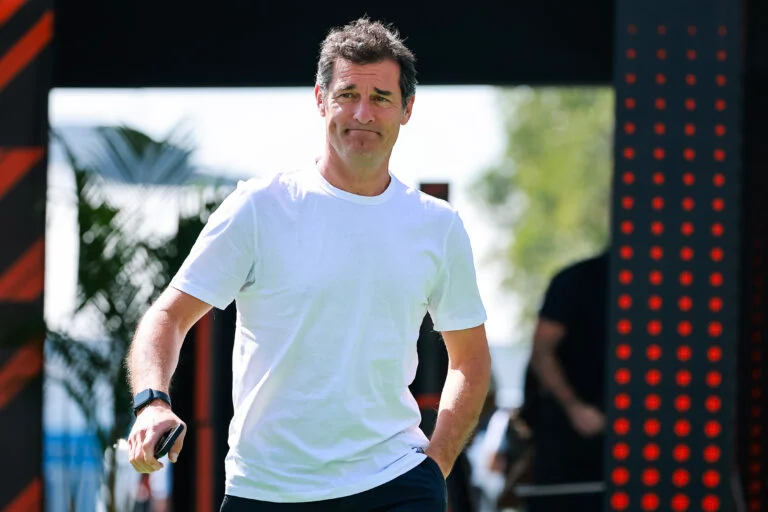
Former Formula 1 driver David Coulthard has sparked conversation across the motorsport world after suggesting that Mark Webber’s reduced involvement in managing rising star Oscar Piastri was “inevitable.” His comments come at a time when Piastri is rapidly establishing himself as one of the most exciting young talents on the Formula 1 grid, prompting questions about how management dynamics evolve as drivers mature.
Coulthard, known for his candid analysis and deep understanding of the sport, pointed to the natural progression that occurs when a driver transitions from a developing prospect into a fully independent competitor. According to him, while Webber played a crucial role in guiding Piastri through the early stages of his career, there comes a point where external management must step back to allow the driver to take full control of their professional journey.
 Mark Webber’s influence on Piastri’s rise cannot be overstated. After retiring from Formula 1, Webber became heavily involved in mentoring young talent, with Piastri emerging as his most notable protégé. Under Webber’s guidance, Piastri enjoyed a meteoric rise through the junior categories, winning championships and building a reputation for composure and consistency well beyond his years.
However, as Coulthard emphasized, Formula 1 is a unique environment where drivers are expected to operate as complete professionals, both on and off the track. This includes handling media responsibilities, contract negotiations, and internal team relationships. As Piastri continues to grow within his team, the need for a more autonomous approach becomes increasingly apparent.
Coulthard suggested that this shift is not indicative of any falling out between Webber and Piastri, but rather a sign of success. In his view, a manager’s ultimate goal is to prepare a driver to stand on their own, and stepping back is often part of that process. The transition reflects Piastri’s growing confidence and ability to navigate the complexities of Formula 1 without constant oversight.
For Piastri, this evolution comes at a pivotal moment in his career. Having already impressed with his performances, he is now entering a phase where expectations are higher and scrutiny is more intense. Every decision, both on track and behind the scenes, carries greater weight, making independence an essential trait for long-term success.
The dynamic between drivers and their managers has always been an intriguing aspect of Formula 1. Some drivers maintain close relationships with their mentors throughout their careers, while others gradually distance themselves as they establish their own identity within the sport. Coulthard’s remarks highlight that there is no one-size-fits-all approach, but rather a spectrum of arrangements that change over time.
Webber himself is likely to remain an important figure in Piastri’s career, even if his day-to-day involvement has diminished. His experience as a former driver provides invaluable insight, and his presence as a trusted advisor could still play a role in key decisions. The difference now is that Piastri is increasingly taking the lead in shaping his own path.
Coulthard’s perspective also underscores the broader reality of Formula 1 as a results-driven environment. Teams prioritize performance above all else, and drivers must align themselves accordingly. As Piastri continues to prove his capabilities, his standing within the team naturally strengthens, further reinforcing the shift toward independence.
Ultimately, the situation reflects a positive trajectory for Oscar Piastri. The notion that Webber’s reduced role was “inevitable” speaks to the young driver’s growth and readiness to take on greater responsibility. While the mentorship that helped him reach Formula 1 remains an important part of his story, the next chapter appears to be one where Piastri stands firmly on his own, shaping his future at the pinnacle of motorsport.
About the Author