Exclusive: Stefano Domenicali Confirms Formula 1 Will Adjust New Rules
There’s a certain kind of silence that falls over a sport when change arrives too quickly. Not the peaceful kind, but the thoughtful, watchful pause where fans, teams, and drivers all lean in a little closer, trying to understand what comes next. That’s where Formula 1 finds itself today—caught between innovation and expectation, evolution and tradition. The engines are still roaring, the lights still go out, but beneath the spectacle, something deeper is being questioned.
For months now, conversations have circled around the new regulations. Some see them as bold and necessary, a step toward a more competitive and sustainable future. Others aren’t so convinced. They speak of lost identity, of racing that feels just a little different, of a sport trying to balance its heritage with the demands of a modern audience. It’s not outrage—but it’s not full acceptance either. It’s uncertainty. And in Formula 1, uncertainty is often the beginning of something much bigger.
Yet, while debates continue across paddocks and social media timelines, one thing remains undeniable—the sport is growing. New fans are arriving from every corner of the world, drawn in by the drama, the personalities, and the sheer intensity of wheel-to-wheel racing. Circuits are selling out faster than ever, and global viewership continues to climb. It’s a paradox of sorts: a sport being questioned internally while simultaneously expanding externally. And somewhere within that contradiction lies the real story.
Because behind the scenes, leadership is not standing still.
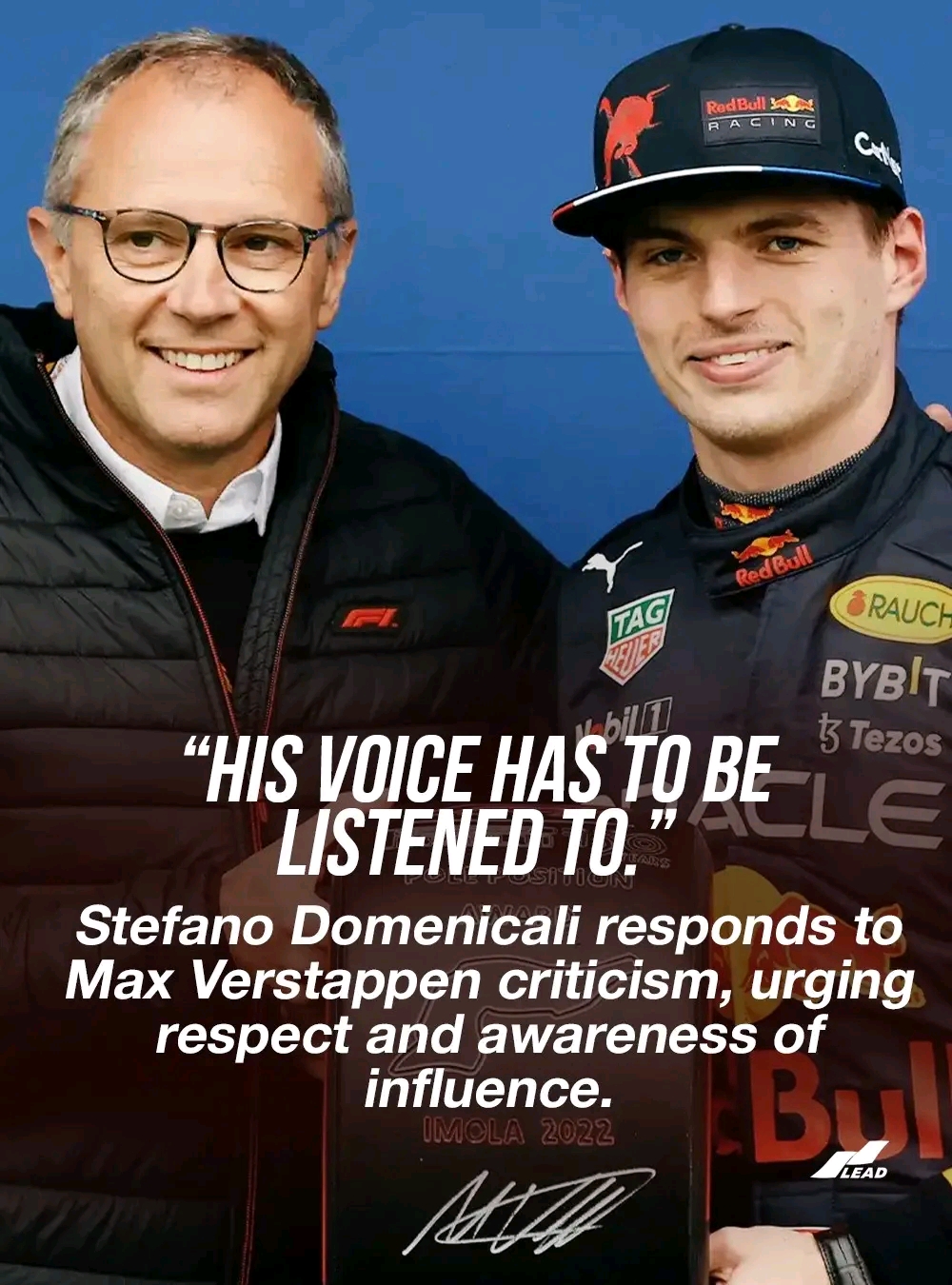
At the center of it all is Stefano Domenicali, a figure who has quietly but confidently been steering the sport through one of its most transformative periods. And now, in what many are calling a defining moment, Domenicali has made his stance clear. The new regulations, he insists, are not a mistake—but they are not untouchable either. Adjustments are coming. Not as a reaction to criticism, but as part of a continuous process of refinement.
This is where the narrative shifts.
Domenicali’s message is simple, yet powerful: Formula 1 is evolving, and evolution requires flexibility. The regulations introduced were designed with a long-term vision in mind—closer racing, greater sustainability, and a more level playing field. But like any ambitious project, real-world performance matters more than theoretical perfection. If something isn’t working as intended, it will be addressed. Not dramatically, not hastily—but carefully, strategically, and with the future in mind.
And perhaps that’s the most important detail of all.
Because while critics focus on what needs fixing, Domenicali is looking at what’s already working. The surge in global interest isn’t accidental. It’s the result of years of deliberate effort to make the sport more accessible, more engaging, and more relevant to a new generation of fans. From digital expansion to new race locations, Formula 1 has positioned itself as more than just a racing series—it’s becoming a global entertainment powerhouse.
Still, the balancing act is delicate.
Too much change, and the sport risks losing its core identity. Too little, and it risks falling behind in a rapidly evolving world. Domenicali seems fully aware of this tension, and that’s what makes his confidence so significant. It’s not blind optimism—it’s calculated belief. A belief that Formula 1 is not just surviving this transition, but thriving within it.
So while the noise around the regulations continues, the bigger picture is becoming clearer.
This isn’t a sport in crisis. It’s a sport in motion.
And if Domenicali is right, then what we’re witnessing isn’t the beginning of a problem—it’s the early stages of something far more important. A recalibration. A fine-tuning. The kind of behind-the-scenes evolution that rarely grabs headlines but ultimately defines eras.
The real question now isn’t whether Formula 1 is on the right track.
It’s whether everyone else is ready to keep up with where it’s going next.
About the Author