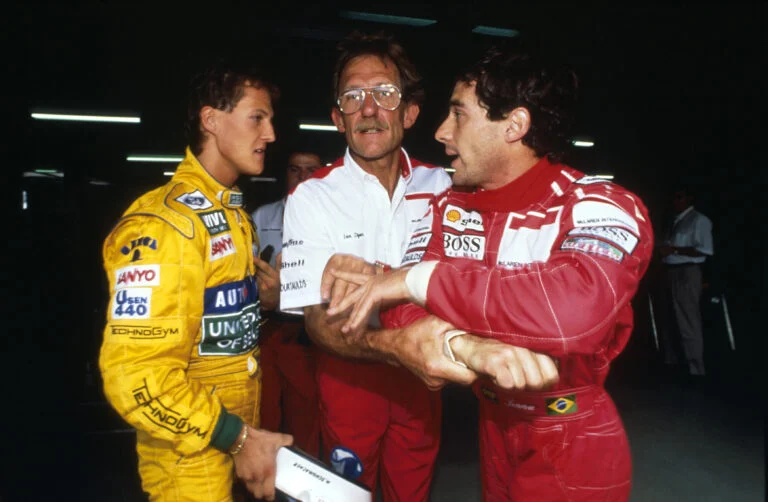
The rivalry between Michael Schumacher and Ayrton Senna remains one of the most fascinating chapters in the history of Formula One. Both drivers were fiercely competitive, immensely talented, and unwilling to yield even an inch on track. One particular flashpoint that perfectly captured their intense dynamic occurred during the 1992 German Grand Prix, where tensions boiled over in dramatic fashion.
 At the time, Schumacher was still an emerging star, racing for Benetton Formula, while Senna was already a multiple world champion with McLaren. The contrast between the young challenger and the established legend added an extra layer of intrigue to their interactions. Schumacher was rapidly gaining a reputation for his aggressive driving style, something that often put him in direct conflict with more experienced competitors.
During the race weekend at Hockenheim, a high-speed and unforgiving circuit, an on-track incident between the two drivers sparked controversy. Details of the clash vary depending on perspective, but it is widely remembered as a moment when Schumacher’s assertiveness crossed paths with Senna’s expectations of racing etiquette. Both drivers believed they were in the right, setting the stage for a heated exchange off the track.
After the incident, Senna reportedly confronted Schumacher to discuss what had happened. Known for his strong principles and intense personality, Senna did not shy away from challenging drivers he felt had acted improperly. However, Schumacher, equally determined and confident in his own judgment, was not willing to back down.
In a moment that has since become part of Formula One folklore, Schumacher is said to have bluntly told Senna to “get lost.” The remark shocked many at the time, not only because of its directness but also because it came from a relatively new driver addressing one of the sport’s biggest icons. It was a clear signal that Schumacher was not intimidated by reputation or status.
The exchange highlighted a generational shift within Formula One. Schumacher represented a new wave of drivers who were prepared to challenge the established order without hesitation. His refusal to defer to Senna, even verbally, demonstrated a mindset that would later define his championship-winning career. It also showed the psychological aspect of racing, where confidence and mental strength can be as important as speed.
For Senna, the incident reinforced his role as both a competitor and a guardian of racing standards. He was known for confronting drivers he believed had overstepped the mark, and his interaction with Schumacher was consistent with that approach. While the two shared mutual respect for each other’s abilities, moments like this revealed the underlying tension that came with competing at the highest level.
In the years that followed, Schumacher would go on to dominate Formula One, becoming one of the most successful drivers in history. Senna, meanwhile, continued to cement his legacy as one of the sport’s greatest talents before his tragic death in 1994. Their brief but intense rivalry remains a topic of discussion among fans and analysts alike.
Looking back, the 1992 German Grand Prix incident serves as more than just a heated argument—it symbolizes the meeting of two eras. It captures the moment when a rising star boldly stood up to a reigning legend, setting the tone for the battles that would define Formula One in the years to come.
Ultimately, the exchange between Schumacher and Senna is remembered not for hostility alone, but for what it revealed about both men: their uncompromising nature, their passion for racing, and their refusal to accept anything less than absolute commitment on the track.
About the Author