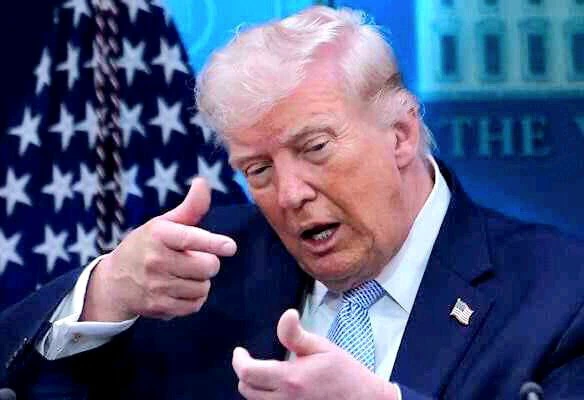
United States President Donald Trump has once again placed Iran at the center of global geopolitical discourse, declaring that he is open to negotiating a deal with the country while firmly insisting that it must never obtain nuclear weapons. His remarks come amid heightened tensions and fragile diplomatic efforts in the Middle East, where both confrontation and negotiation appear to be unfolding simultaneously.
 Trump’s position reflects a dual-track strategy that has defined much of his approach toward Iran: a willingness to engage diplomatically paired with uncompromising red lines. Central among those red lines is Iran’s nuclear capability. According to recent statements, Trump emphasized that while a deal is desirable, it would be meaningless if it allowed Iran to develop or possess nuclear weapons.
This stance is not new. Trump has repeatedly framed the prevention of a nuclear-armed Iran as the cornerstone of his foreign policy. Over the years, he has consistently argued that nuclear weapons in the hands of Tehran would destabilize not only the Middle East but also global security. His latest comments therefore reinforce a long-standing doctrine rather than signaling a shift in policy.
However, the context surrounding these remarks is significantly more volatile than in previous years. Recent developments suggest that indirect communication between Washington and Tehran may be ongoing, with Trump claiming that Iran has shown interest in reaching an agreement. Yet, these claims remain difficult to independently verify, adding an element of uncertainty to the situation.
Complicating matters further is the broader military and economic pressure campaign being applied by the United States. Reports indicate that measures such as naval blockades and disruptions to key trade routes have been implemented, particularly around the strategically vital Strait of Hormuz. These actions are designed to weaken Iran’s leverage while pushing it toward negotiations, but they have also drawn criticism from international allies.
The diplomatic impasse appears to center on Iran’s nuclear program, specifically uranium enrichment. During recent talks, the United States reportedly proposed a long-term halt to Iran’s enrichment activities, a condition Tehran has been reluctant to accept. This issue has historically been one of the most contentious aspects of any potential agreement, and it continues to be a major obstacle.
Trump’s rhetoric also reflects a broader strategic philosophy often described as “maximum pressure.” By combining economic sanctions, military posturing, and diplomatic overtures, his administration aims to force Iran into concessions. Critics, however, argue that this approach risks escalating tensions and undermining trust, making a sustainable agreement harder to achieve.
At the same time, Trump has sought to portray his position as ultimately beneficial for Iran. He has frequently stated that he wants the country to prosper economically and politically, provided it abandons its pursuit of nuclear weapons. This framing attempts to balance hardline security concerns with an appeal to potential mutual benefits.
International reactions to Trump’s stance have been mixed. Some allies support the objective of preventing nuclear proliferation but question the methods being used, particularly the reliance on unilateral pressure tactics. Others worry that the current approach could lead to further instability in an already fragile region, especially if negotiations collapse entirely.
Ultimately, Trump’s declaration underscores the enduring complexity of U.S.-Iran relations. The prospect of a deal remains uncertain, caught between competing demands, deep mistrust, and geopolitical maneuvering. What is clear, however, is that the issue of nuclear weapons remains the defining factor—one that will likely determine whether diplomacy succeeds or fails in the months ahead.
About the Author