THE SCREAM IS BACK: F1 DITCHES BATTERIES FOR 1000HP V10 FUTURE
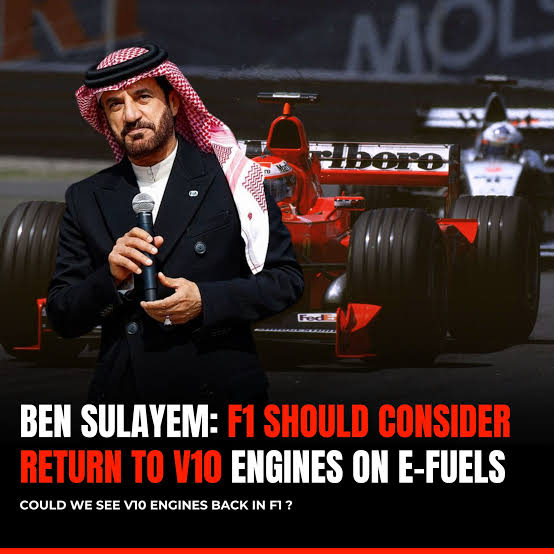
LONDON NEWS — In a stunning reversal that has sent shockwaves through the automotive world, the FIA has announced that Formula 1 will abandon hybrid technology entirely, returning to pure, high-revving, naturally aspirated V10 engines starting in 2028.
After years of fan backlash regarding quiet engines, excessive car weight, and “lift-and-coast” racing, governing body president Mohammed Ben Sulayem confirmed the radical shift. The decision aims to bring back the “purist” element of motorsport, prioritizing driver skill and visceral sound over energy management.
The 2026-2027 regulations will serve as a transitional phase, featuring the planned V6 hybrid engines, before a total reset. Manufacturers have been given the green light to develop 2.4-liter, 1000-horsepower V10 engines, restricted only by the requirement to run on 100% sustainable, net-zero synthetic fuel.
“We heard the fans, we saw the data, and we felt the emotion,” Ben Sulayem announced at a special press conference in London. “Formula 1 is entertainment. It is sound. It is speed. We are going back to the golden era, but with the clean technology of the future.”
This landmark decision means all battery packs, complex MGU-H, and MGU-K units will be stripped from the cars. This will immediately drop the minimum weight of the cars by over 150 kilograms, leading to agile machines that can follow each other closely without overheating or destroying their tires.
“No more electrical boost buttons. No more energy harvesting. Just a pure racing engine and a driver who has to handle 1000hp,” added a team principal.
The main point is this: By adopting 100% sustainable, carbon-neutral synthetic fuels, Formula 1 has proven that the V10 engine can be both environmentally responsible and breathtakingly exciting, allowing cars to be lighter, louder, and faster without the need for complicated battery hybrid systems.
Teams such as Ferrari and Red Bull have reportedly welcomed the decision, with insiders noting that the cost of developing a traditional, naturally aspirated engine is significantly lower than the current complex power units.
Fans have long argued that the sound of the engine is part of F1’s DNA. The return of the high-pitched “scream” is expected to increase live event attendance dramatically.
The 2028 season will be remembered as the year F1 brought back the roar, letting the true racers race once again
About the Author