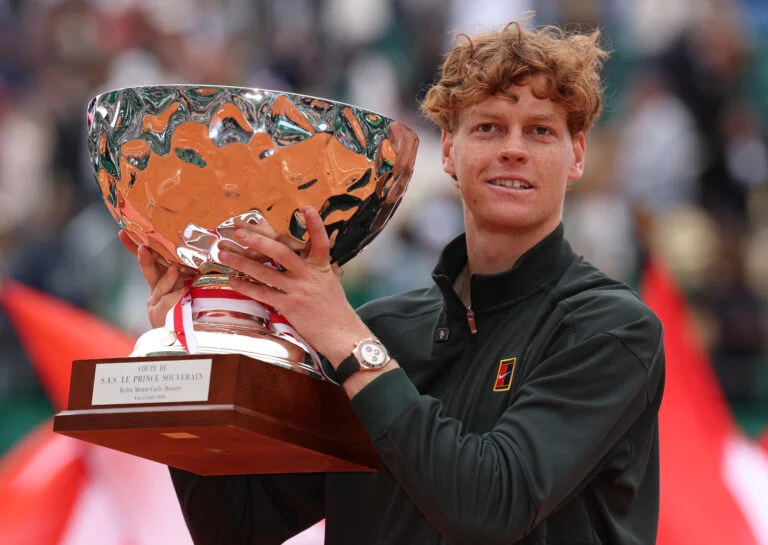
The Monte-Carlo Masters final between Carlos Alcaraz and Jannik Sinner delivered a spectacle of elite tennis, but it wasn’t just the players’ performances that caught attention. Former world No. 1 Andy Murray made headlines of his own after openly criticizing the playing conditions during the match. His remarks sparked conversation across the tennis world, adding another layer of intrigue to an already high-profile encounter.
 The final, staged at the prestigious Monte-Carlo Masters, saw two of the sport’s brightest young stars battle for supremacy on clay. However, despite the glamour of the event and the high level of competition, Murray pointed out that the conditions on court were far from ideal. According to him, factors such as court speed, surface consistency, and weather played a significant role in shaping the match.
Murray, known for his candid opinions, took to social media during the match to voice his concerns. He suggested that the clay surface appeared unusually slow and heavy, which made it difficult for players to execute their usual attacking styles. This, he argued, led to longer rallies and disrupted the natural rhythm of both Alcaraz and Sinner.
The British veteran also highlighted how the weather conditions impacted play. With cooler temperatures and occasional dampness in the air, the ball was reportedly not traveling as quickly as it typically would on a clay court. Murray emphasized that such conditions can significantly alter the dynamics of a match, especially when both players rely heavily on timing and precision.
For Alcaraz, whose explosive movement and aggressive shot-making are key components of his game, the slower conditions may have forced adjustments. Similarly, Sinner, known for his clean ball-striking and ability to dictate play, had to adapt to a court that did not reward his usual pace. Murray’s observations suggested that both players were competing not only against each other but also against the environment.
Despite these challenges, the quality of tennis remained high. Both players showcased resilience, tactical awareness, and mental strength as they navigated the difficult conditions. Murray acknowledged this as well, noting that it is often in such परिस्थितियाँ that true champions demonstrate their adaptability and composure.
Murray’s comments also reignited a broader discussion about consistency in tournament conditions across the ATP Tour. Players and analysts have long debated whether more should be done to standardize surfaces and playing environments to ensure fairness. His remarks added weight to these ongoing conversations, given his experience and reputation within the sport.
Fans and pundits were divided in their reactions. Some agreed with Murray’s assessment, pointing out visible differences in ball speed and bounce during the match. Others argued that dealing with varying conditions is part of the sport and that adaptability is a key skill for any top player.
In the end, the Monte-Carlo final will be remembered not only for the clash between Alcaraz and Sinner but also for Murray’s outspoken critique. His willingness to speak up once again demonstrated his passion for the game and his desire to see it played under the best possible conditions.
As the clay-court season progresses, attention will likely remain on how conditions affect matches at major tournaments. Murray’s comments may even prompt organizers to take a closer look at court preparation and environmental factors. For now, his observations have added a thought-provoking subplot to one of the most exciting rivalries in modern tennis.
About the Author